Executive Summary
By 2026, the global AI narrative has shifted from experimental pilots to a demand for measurable returns. According to McKinsey’s State of AI in 2025, 88% of organizations now use AI regularly, yet only 39% report a meaningful impact on their earnings before interest and taxes. Despite $252 billion in global investment, most companies have tools and pilots but have not updated their operating models. Research from Boston Consulting Group indicates that only 5% of companies realize scalable business value from AI because most treat the technology as a simple addition rather than a fundamental shift in how work is performed. To bridge this gap, organizations must adopt a structured four-phase roadmap that prioritizes leadership alignment, workforce enablement, and disciplined governance before attempting to scale.
The 2026 AI Reality
The market has adjusted its expectations as the initial novelty of artificial intelligence fades. In 2025, Gartner placed Generative AI in the Trough of Disillusionment, noting that fewer than 30% of AI leaders report that their CEOs are satisfied with investment returns. This dissatisfaction exists despite average spending on Generative AI approaching $2 million per organization in 2024.
While technology continues to advance, organizational readiness remains the primary bottleneck. For example, 62% of organizations are currently piloting agentic systems capable of executing multi-step tasks autonomously, but only 23% are successfully scaling them. Furthermore, McKinsey finds that only 28% of organizations explicitly assign CEO-level responsibility for the AI agenda and governance. Companies that achieve high returns focus on workflow redesign rather than technology procurement, recognizing that AI tools fail when treated as plug and play solutions.
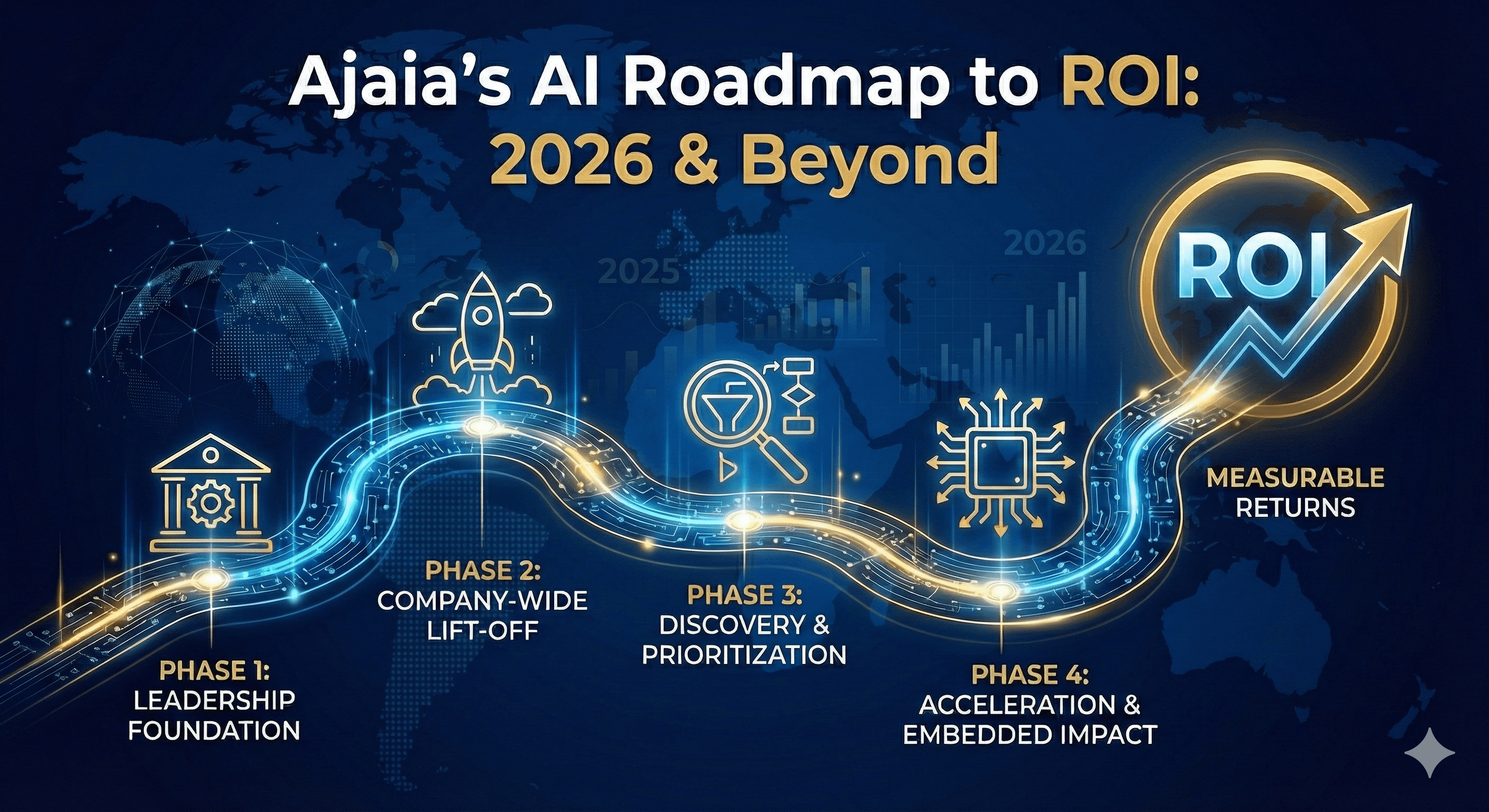
Ajaia’s Four-Phase Roadmap to ROI
Organizations seeing measurable returns follow a specific sequence. They build understanding before acceleration, alignment before automation, and trust before scale.
Phase 1: Leadership AI Foundation
Measurable ROI begins with the executive suite. In successful organizations, leaders share a practical understanding of where AI creates economic leverage.
Executives must understand the realistic capabilities and limitations of the technology.
Leaders identify where AI can change cost, speed, or quality at a structural level.
Clear principles for governance are established to build trust.
This foundation prevents reactive behavior and turns AI into a strategic capability.
Phase 2: Company-Wide AI Lift-Off
Once leadership is aligned, the focus moves to enabling broad and responsible engagement across the workforce.
Organizations provide secure and governed access that employees can trust.
Generic training is replaced by role-specific instruction on how AI applies to daily tasks.
Early productivity gains build credibility and surface signals for deeper value.
The outcome is momentum where AI becomes a standard part of the operating model.
Phase 3: AI Use-Case Discovery and Prioritization
As participation grows, organizations must introduce discipline to manage the high volume of ideas.
Workflows are evaluated based on their ability to materially change cost, speed, or quality.
Ideas are judged on feasibility and impact rather than technical novelty.
The output is a prioritized roadmap that leadership can invest behind with confidence.
Phase 4: AI Acceleration and Embedded Impact
Acceleration only delivers returns when the organizational foundations are ready to absorb the change.
Bespoke AI systems and intelligent agents are integrated directly into core operations.
Governance frameworks enable speed by providing clear guardrails instead of creating friction.
Returns compound because the organization has the maturity to scale impact across the enterprise.
AI outcomes follow ownership. When CEOs delegate AI as a technical initiative, progress fragments. To ensure AI becomes a competitive advantage, there are four decisions only a CEO can make:
Framing: You must articulate whether AI is intended for marginal optimization or a total transformation of how the organization operates. Without this clarity, teams default to local tool accumulation.
Sequencing: You must insist on enablement before pushing for scale. This includes ensuring leadership understanding and workforce readiness are in place to prevent organizational drag.
Focus: You must prioritize material opportunities that affect the bottom line. Deprioritize the noise of interesting but economically immaterial use cases.
Measurement: You must track progress by changes in how work gets done and the outcomes achieved. Do not measure success by the number of tools deployed or pilots launched.
Conclusion: From Activity to Advantage
The era of AI novelty has ended and the era of accountability has begun. Organizations that skipped enablement to go straight to deployment are currently facing high investments and low impact. This is reflected in research from Deloitte showing that payback periods for Generative AI now average two to four years
The 5% of companies achieving significant returns treat AI as an operating capability rather than a technology project. Advantage comes from organizational readiness and the discipline to build foundations that allow technology to change the nature of work. CEOs who lead this transition will see compounding returns, while those who continue to delegate it as a technical task will continue to struggle with underwhelming results