The Opportunity
The client’s primary revenue channel depended on submitting a high volume of competitive, well-structured RFP responses. However, proposal creation required weeks of effort, involved 5+ stakeholders per bid, and was constrained by fragmented knowledge, inconsistent templates, and limited team bandwidth.
Key Challenges
Proposal drafting required multiple weeks and 5–7 contributors, creating major bottlenecks that capped the number of bids the organization could pursue.
Institutional knowledge was scattered across documents and individuals, increasing inconsistency and risking major gaps whenever staff turned over.
RFP compliance checks were manual and slow, forcing teams to read hundreds of pages just to identify requirements—delaying submission timelines.
Informal prompt usage and ad-hoc AI tools produced unreliable outputs, offered no scalability, and lacked the security required for sensitive government material.
The Process
Step 1: Discovery & Knowledge Mapping
Conducted stakeholder sessions to understand proposal types, structure, required sections, writing workflows, and institutional knowledge unique to the organization.
Step 2: Proposal Workflow Analysis
Mapped existing proposal cycles, identified repetitive sections, and analyzed bottlenecks such as compliance checklist creation, narrative drafting, and content retrieval.
Step 3: Architecture & Multi-Agent Design
Designed a multi-agent proposal-writing infrastructure: specialized agents for different proposal types, sections, compliance checks, and content assembly.
Step 4: Platform Build & AI Integration
Developed the full platform end-to-end, integrating secure AI models, scalable components, organizational knowledge bases, and export-ready templates.
Step 5: Model Configuration & Prompting
Configured advanced, domain-aligned prompting flows and grounded each agent in curated knowledge bases to ensure accuracy, consistency, and federal-grade compliance.
Step 6: Deployment & Enablement
Deployed the system into the client environment, trained proposal teams, and created guidance for ongoing usage, content updates, and template expansion.
The Opportunity
The client’s primary revenue channel depended on submitting a high volume of competitive, well-structured RFP responses. However, proposal creation required weeks of effort, involved 5+ stakeholders per bid, and was constrained by fragmented knowledge, inconsistent templates, and limited team bandwidth.
Key Challenges
Proposal drafting required multiple weeks and 5–7 contributors, creating major bottlenecks that capped the number of bids the organization could pursue.
Institutional knowledge was scattered across documents and individuals, increasing inconsistency and risking major gaps whenever staff turned over.
RFP compliance checks were manual and slow, forcing teams to read hundreds of pages just to identify requirements—delaying submission timelines.
Informal prompt usage and ad-hoc AI tools produced unreliable outputs, offered no scalability, and lacked the security required for sensitive government material.
The Process
Step 1: Discovery & Knowledge Mapping
Conducted stakeholder sessions to understand proposal types, structure, required sections, writing workflows, and institutional knowledge unique to the organization.
Step 2: Proposal Workflow Analysis
Mapped existing proposal cycles, identified repetitive sections, and analyzed bottlenecks such as compliance checklist creation, narrative drafting, and content retrieval.
Step 3: Architecture & Multi-Agent Design
Designed a multi-agent proposal-writing infrastructure: specialized agents for different proposal types, sections, compliance checks, and content assembly.
Step 4: Platform Build & AI Integration
Developed the full platform end-to-end, integrating secure AI models, scalable components, organizational knowledge bases, and export-ready templates.
Step 5: Model Configuration & Prompting
Configured advanced, domain-aligned prompting flows and grounded each agent in curated knowledge bases to ensure accuracy, consistency, and federal-grade compliance.
Step 6: Deployment & Enablement
Deployed the system into the client environment, trained proposal teams, and created guidance for ongoing usage, content updates, and template expansion.
The Opportunity
The client’s primary revenue channel depended on submitting a high volume of competitive, well-structured RFP responses. However, proposal creation required weeks of effort, involved 5+ stakeholders per bid, and was constrained by fragmented knowledge, inconsistent templates, and limited team bandwidth.
Key Challenges
Proposal drafting required multiple weeks and 5–7 contributors, creating major bottlenecks that capped the number of bids the organization could pursue.
Institutional knowledge was scattered across documents and individuals, increasing inconsistency and risking major gaps whenever staff turned over.
RFP compliance checks were manual and slow, forcing teams to read hundreds of pages just to identify requirements—delaying submission timelines.
Informal prompt usage and ad-hoc AI tools produced unreliable outputs, offered no scalability, and lacked the security required for sensitive government material.
The Process
Step 1: Discovery & Knowledge Mapping
Conducted stakeholder sessions to understand proposal types, structure, required sections, writing workflows, and institutional knowledge unique to the organization.
Step 2: Proposal Workflow Analysis
Mapped existing proposal cycles, identified repetitive sections, and analyzed bottlenecks such as compliance checklist creation, narrative drafting, and content retrieval.
Step 3: Architecture & Multi-Agent Design
Designed a multi-agent proposal-writing infrastructure: specialized agents for different proposal types, sections, compliance checks, and content assembly.
Step 4: Platform Build & AI Integration
Developed the full platform end-to-end, integrating secure AI models, scalable components, organizational knowledge bases, and export-ready templates.
Step 5: Model Configuration & Prompting
Configured advanced, domain-aligned prompting flows and grounded each agent in curated knowledge bases to ensure accuracy, consistency, and federal-grade compliance.
Step 6: Deployment & Enablement
Deployed the system into the client environment, trained proposal teams, and created guidance for ongoing usage, content updates, and template expansion.
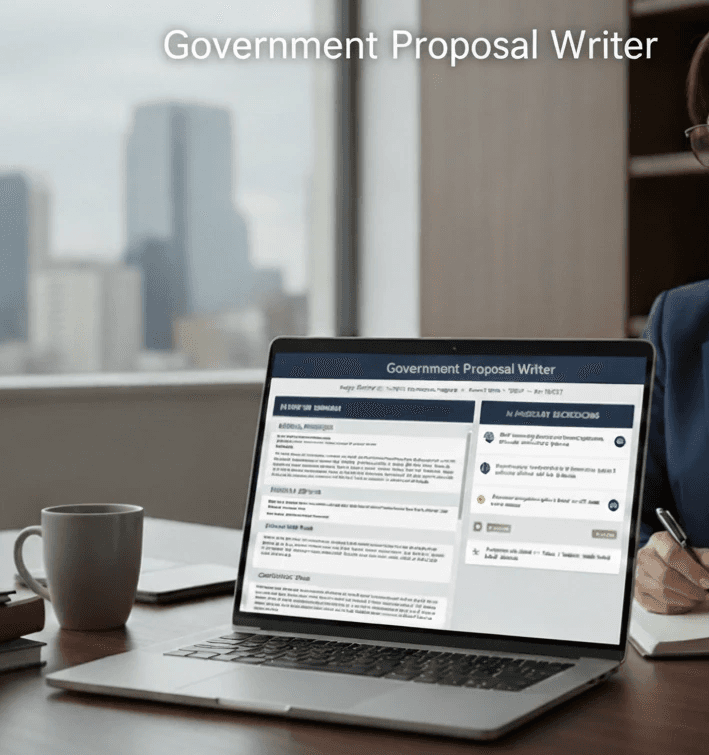
Our Solution Description
The Government Proposal Writer is a secure, multi-agent system that ingests RFPs and automatically produces a complete, well-structured, and branded first draft—typically 70% finished—within minutes. It handles an unlimited number of templates and sections, generates compliance checklists, and grounds every response in the organization’s vetted knowledge base. The architecture is fully scalable and designed to support high bid volume without expanding proposal staff.